What Holds Humans Up: The Three Scaffoldings of Extreme Environments

Roger Garcia in front of DEEP’s Vanguard subsea habitat.
Image credits: DEEP
The previous article ended with a simple but important question:
When humans live underwater, are we designing spaces they can merely endure, or spaces they can actually live in and are habitable?
We also explored:
The difference between livable and habitable environments,
Why habitability often reveals itself in the moments beyond work,
Signals of whether people endured extended time in extreme conditions,
How many of the answers to today’s habitability challenges already exist, embedded in the lived experiences of previous participants, if we choose to listen.
But understanding what habitability demands raises a deeper question: What actually holds humans up once they're inside extreme environments?"
People rarely fail in extreme environments because they lack motivation. More often, failure is attributed to either architecture, leadership, or team dynamics, each in it’s own silos. In reality, breakdown usually occurs when multiple support systems stop working together.
That underlying support comprising of physical, psychological, and organizational is what I refer to as scaffolding.
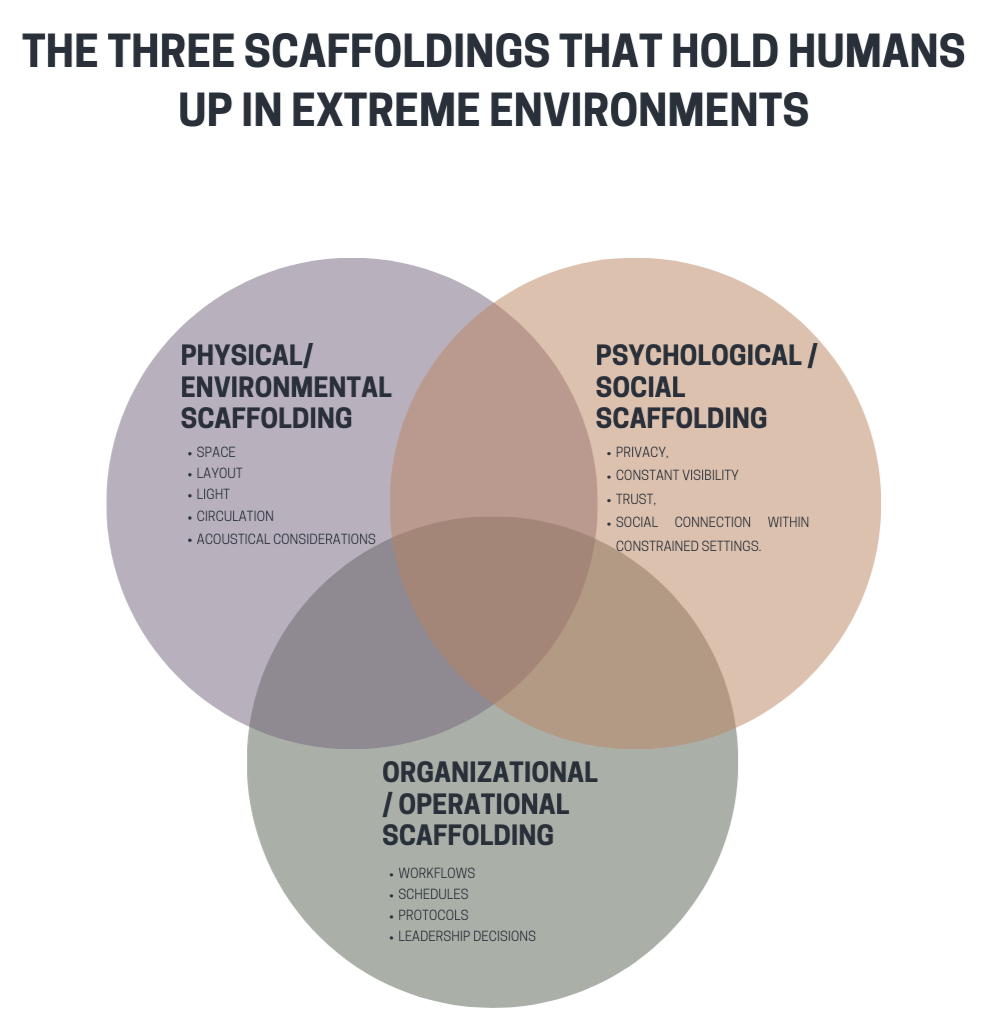
Human endurance in extreme environments depends on multiple scaffoldings working together, not in isolation.
Diagram by Extreme Living
The Three Scaffoldings That Hold Humans Up
As mentioned above, Human performance in extreme environments is rarely sustained by a single factor. It is supported by multiple layers working simultaneously. Through my research, I’ve come to understand these layers as three interdependent scaffoldings: physical, psychological, and organizational.
Like scaffolding in construction, these systems support humans while they operate under conditions that would otherwise be difficult or deeply challenging to endure. When they work well, they fade into the background. But When one weakens, or when they stop working together, strain begins to surface.
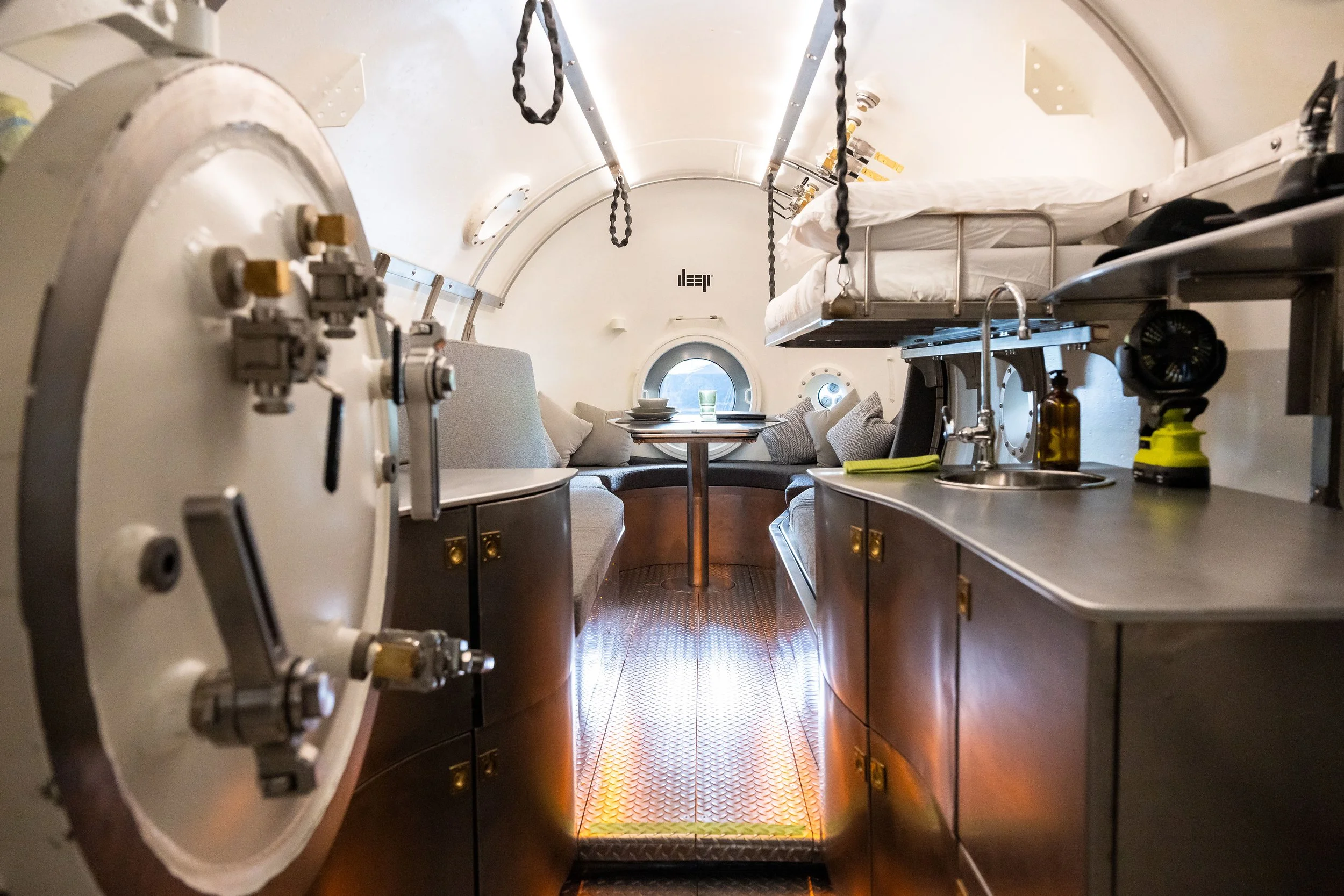
The living chamber shapes how people move, rest, and recover after the workday ends.
Image credits: DEEP
Physical / Environmental Scaffolding
Physical scaffolding is the most visible layer. It includes:
Space,
Layout,
Light,
Circulation
Acoustical considerations & much more
This layer is often mistaken for aesthetics. it is about creating the programmatic conditions required for daily life. Where do people sleep? Where do they retreat? How are work zones separated from living zones, or are they not?
In extreme environments, the strain rarely appears during moments of intense work; it emerges later, in the quieter moments. We explored this dynamic in depth in Article 1.
Psychological / Social Scaffolding
Psychological scaffolding governs how people experience factors such as:
Privacy,
Constant visibility
Trust,
Social connection within constrained settings.
These factors may not seem architectural at first. But architecture plays a significant role in shaping them.
In extreme environments, psychological pressure does not always come from the work itself. It often arises from constant monitoring, limited privacy, and the subtle erosion of personal space. Monitoring may be necessary for safety, but when poorly coordinated with design, it can shift from support to stress or anxiety. We will explore examples of this below.
This scaffolding plays a critical role in whether people feel grounded or exposed. When psychological support is weak, individuals may remain outwardly functional while internally disengaging. Over time, this disconnection affects team cohesion and decision-making, often long before it becomes visible as conflict or burnout.
Organizational / Operational Scaffolding
Organizational scaffolding encompasses elements such as:
Workflows
Schedules
Protocols
Leadership decisions
It shapes the rhythm of daily life.
While not all organizational challenges can be solved through architecture, workflows and operational friction are often influenced and sometimes alleviated by spatial design.
In extreme environments, this scaffolding frequently becomes the mediator between mission objectives, safety constraints, and human limits

Operational spaces reveal how workflows, maintenance, and daily routines are structured behind the scenes. Image credits: DEEP
Rankings & Why Scaffolding Must Work Together - Insights from Roger Garcia
While the three scaffoldings can be described separately, Roger Garcia was clear that they cannot function independently. When asked to rank them, he acknowledged that physical conditions often come first as without a functional environment, nothing else can operate. But he repeatedly emphasized that ranking was far less important than integration.
What stood out in the conversation was not the hierarchy, but his frustration with how often these systems are developed in isolation.
In practice, engineering teams design physical systems. Operations teams inherit them. Psychological impacts are addressed later, if at all. In Roger’s experience, this separation is where problems begin.
Roger's examples revealed two critical failure points: when physical design doesn't align with operations, and when physical design doesn't account for psychological impact."
Where Misalignment Happens: Two Critical Failure Points
Pairings - Physical & Organizational
Roger described moments when engineering teams would formally turn over a system to operations, only for operations staff to become immediately frustrated. The systems were technically sound, but difficult to maintain, overbuilt, or poorly aligned with how work actually unfolded.The issue wasn’t safety. It was that the operational perspective had never been meaningfully included in the design conversation.
As a result, operations teams were forced to compensate through organizational workarounds. And the strain created by that misalignment was absorbed by the people living and working inside the environment.
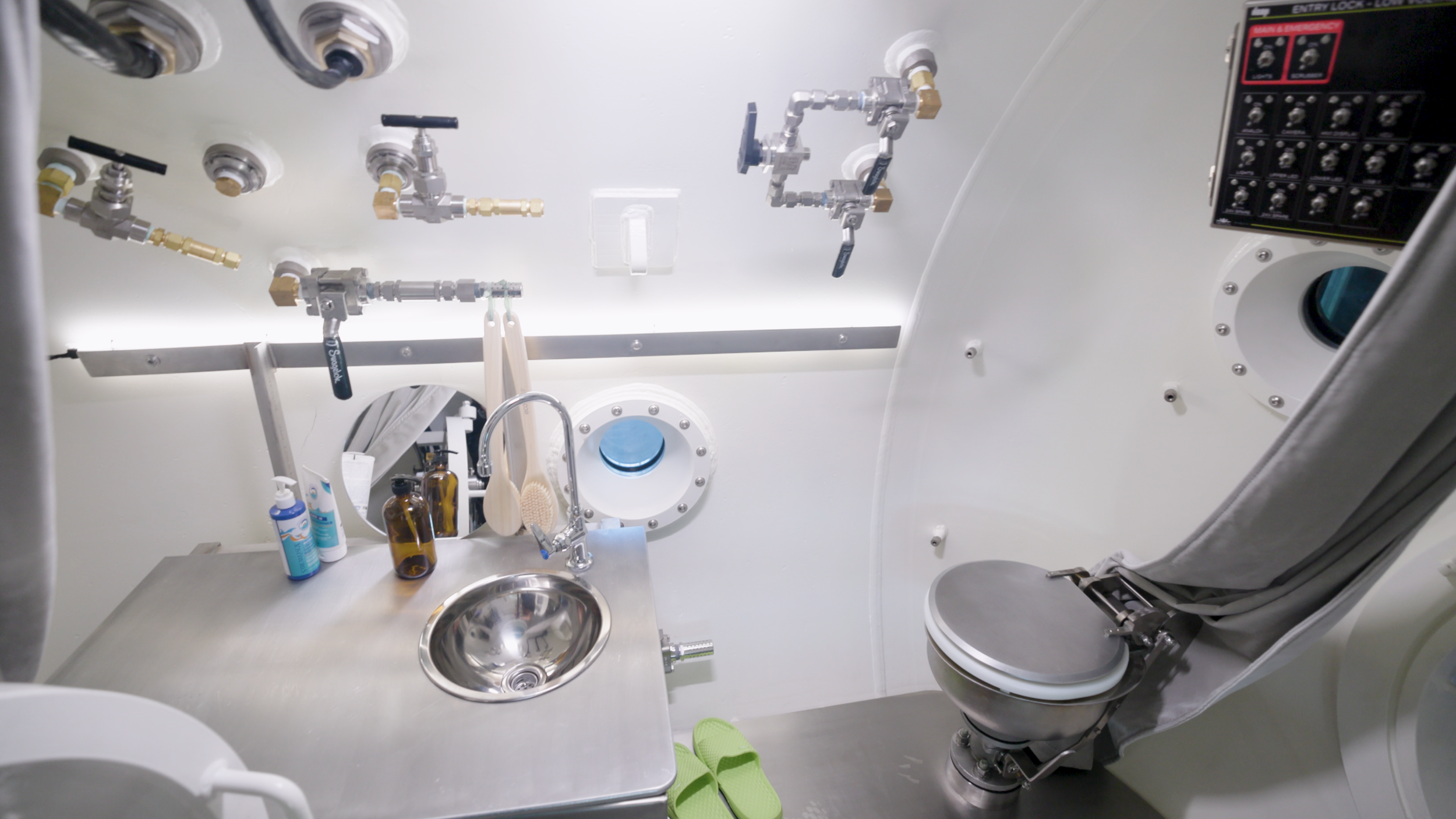
Small spatial decisions can carry disproportionate psychological weight in confined environments.
Image credits: DEEP
Pairings - Physical & Psychological
Roger also emphasized how physical and psychological scaffoldings are deeply intertwined. A spatial decision such as where a restroom is located may seem minor on paper, but it can have psychological consequences.
If a restroom is poorly placed, people may have to interrupt work occurring in monitored spaces, move others out of the way, or feel exposed during basic human activities. Over time, these moments accumulate into stress.
These pressures don’t announce themselves during critical operations. They build quietly in the background, shaping how people feel and interact.
Across Roger’s examples, one pattern remained consistent: failures rarely originate from a single factor. They emerge when physical design, psychological experience, and organizational decisions stop reinforcing one another. And people are left to bridge the gaps themselves.
That interdependence, where each scaffolding either supports or undermines the others is what makes scaffolding effective or fragile. And it is why, as Roger emphasized, these conversations cannot happen sequentially or in silos. They must happen together, early, and continuously, with an open mind toward integration.
When Scaffolding Falls Out of Alignment: A Space Simulation Example
This pattern isn't unique to underwater habitats. Analog astronaut Andrzej Stewart described a similar misalignment during a space simulation.
While living inside a space simulation habitat, something as simple as brushing his teeth became a multi-step process. With no running water, all water was stored separately. His toothbrush and toothpaste were kept at the back of a capsule-style bunk, small enough that he couldn’t stand upright. To brush his teeth, he had to crawl into the bunk to retrieve supplies,go upstairs to collect bottled water, find a cup to spit into, complete the task, and then reverse the entire sequence to put everything back.
And if anything was forgotten, the process had to begin again.
None of these steps were difficult in isolation. But together, they transformed a basic daily activity into a cognitively demanding routine.
What this example reveals is not inconvenience, it’s misalignment.
Roger Garcia’s underwater examples with the pairings above reflected the same pattern: systems that worked technically, but created strain because engineering decisions were made without integrating operations and human experience early in the process.
What Scaffolding Really Holds Up
Taken together, these examples point to a quiet but critical reality: humans don’t break in extreme environments because one system fails outright. They struggle when multiple scaffoldings stop reinforcing one another.
Scaffolding explains how people are supported once they are inside constrained environments. But it doesn't explain everything and reveals why architecture alone is never enough. It doesn't fully address what happens when oversight intensifies, when routines are constantly observed, or when the balance between care and control begins to shift.
That is where the next article begins.

If you’d like to hear the full story in Roger’s own words, our conversation is on the Extreme Living podcast.
https://open.spotify.com/episode/1WhxdhSAeTQ3u5tLhSYmfE
